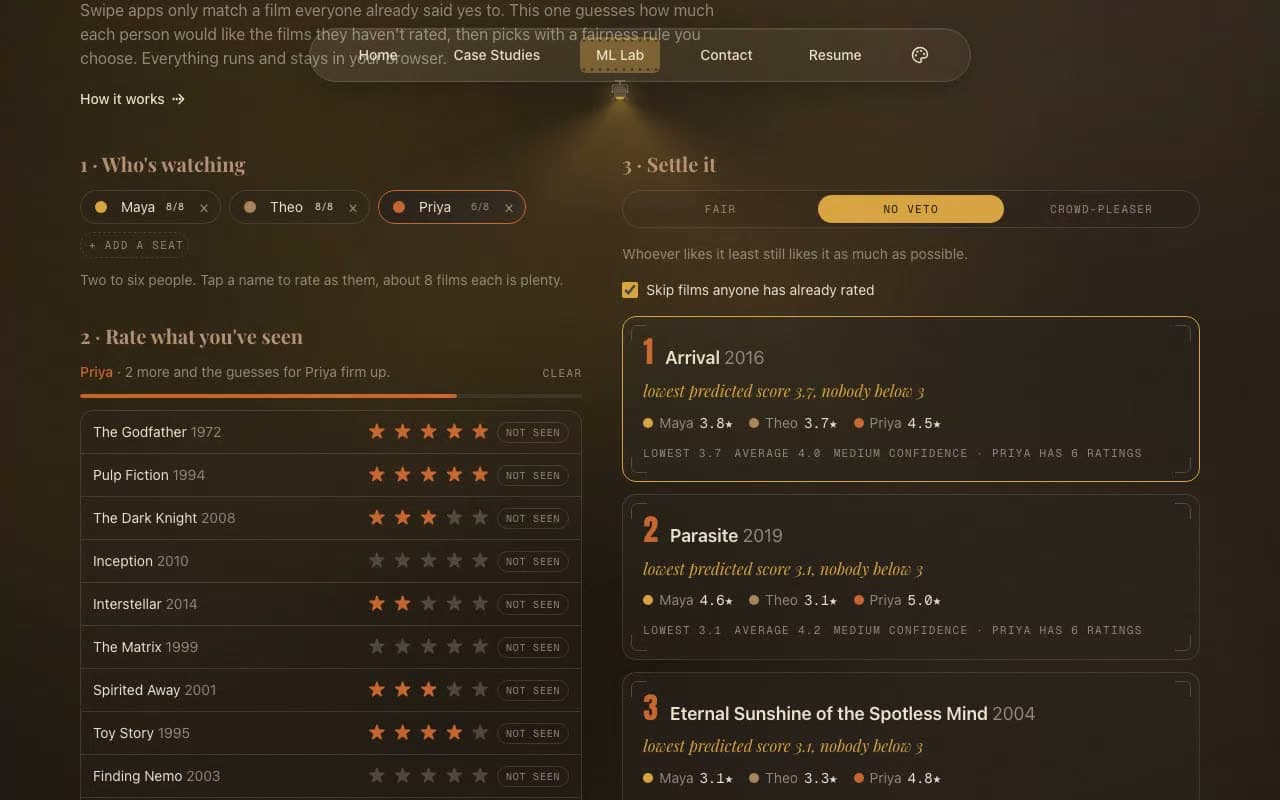
Add everyone on the couch, rate a few films each, and get one film the whole group can live with. A hand trained factor model fills in what each person would think of films they haven't rated, then a fairness rule you pick settles it.
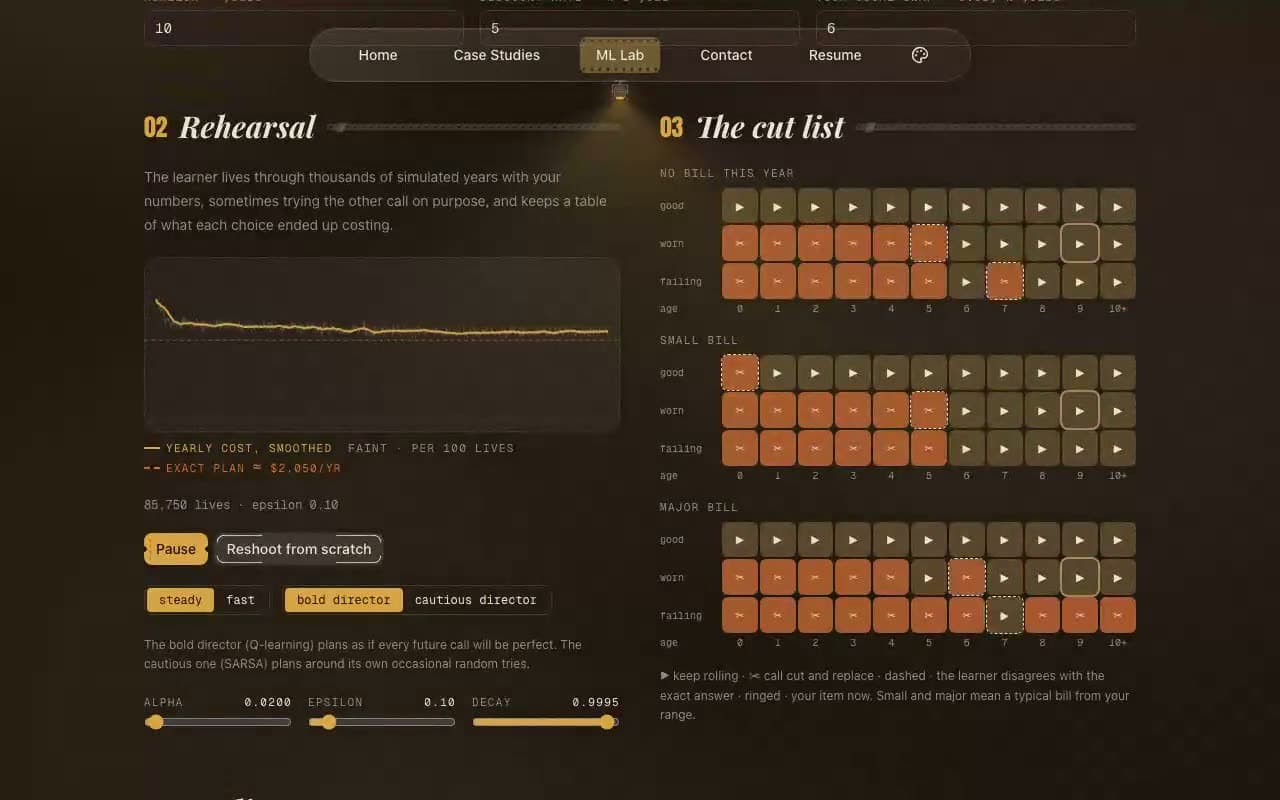
Repair or replace? Enter your car, phone, laptop or fridge and a Q-learner rehearses thousands of simulated years to write a keep or replace plan for every age and condition, then an exact solver checks it cell by cell against the 50% rule.
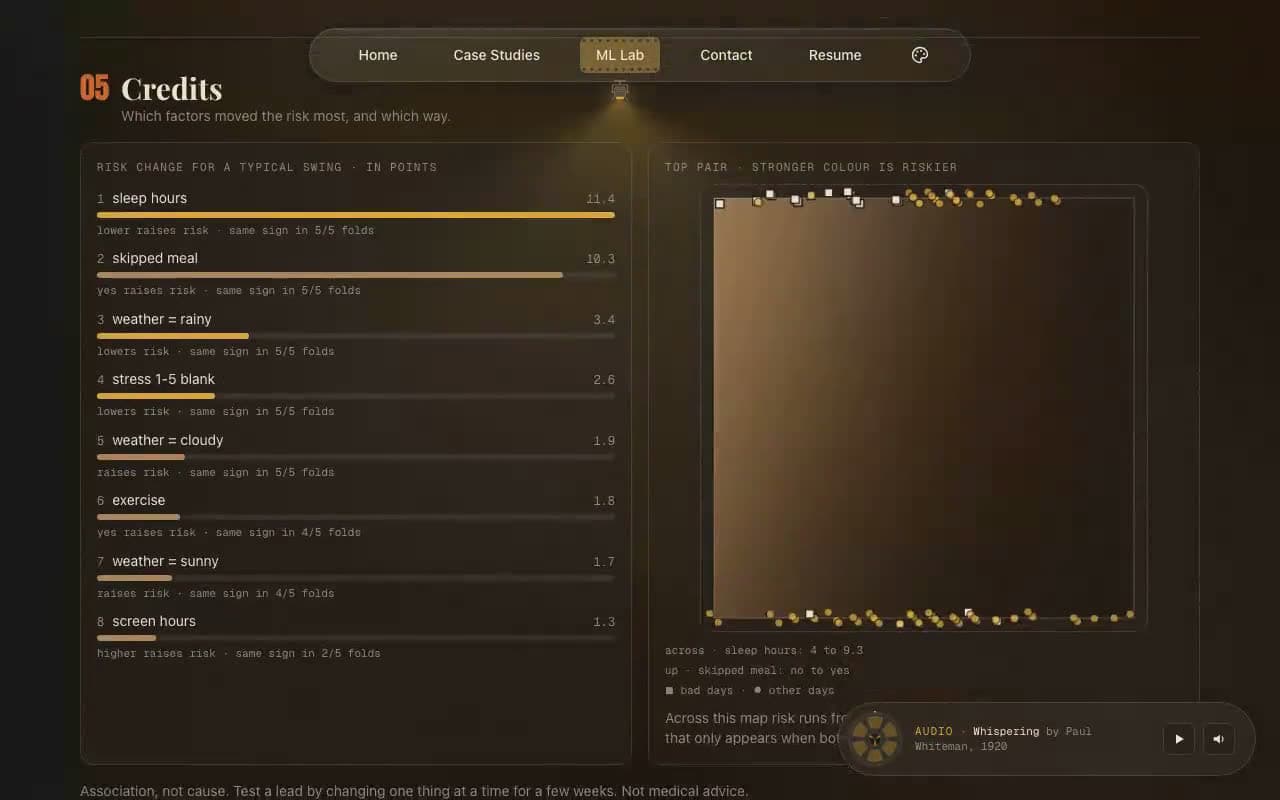
Load your own symptom or mood log and see what tends to come before your bad days, with a plain verdict when there is no signal yet. Underneath, a scalar autograd engine trains an MLP across five folds and ranks factors by input gradients. Nothing leaves the tab.
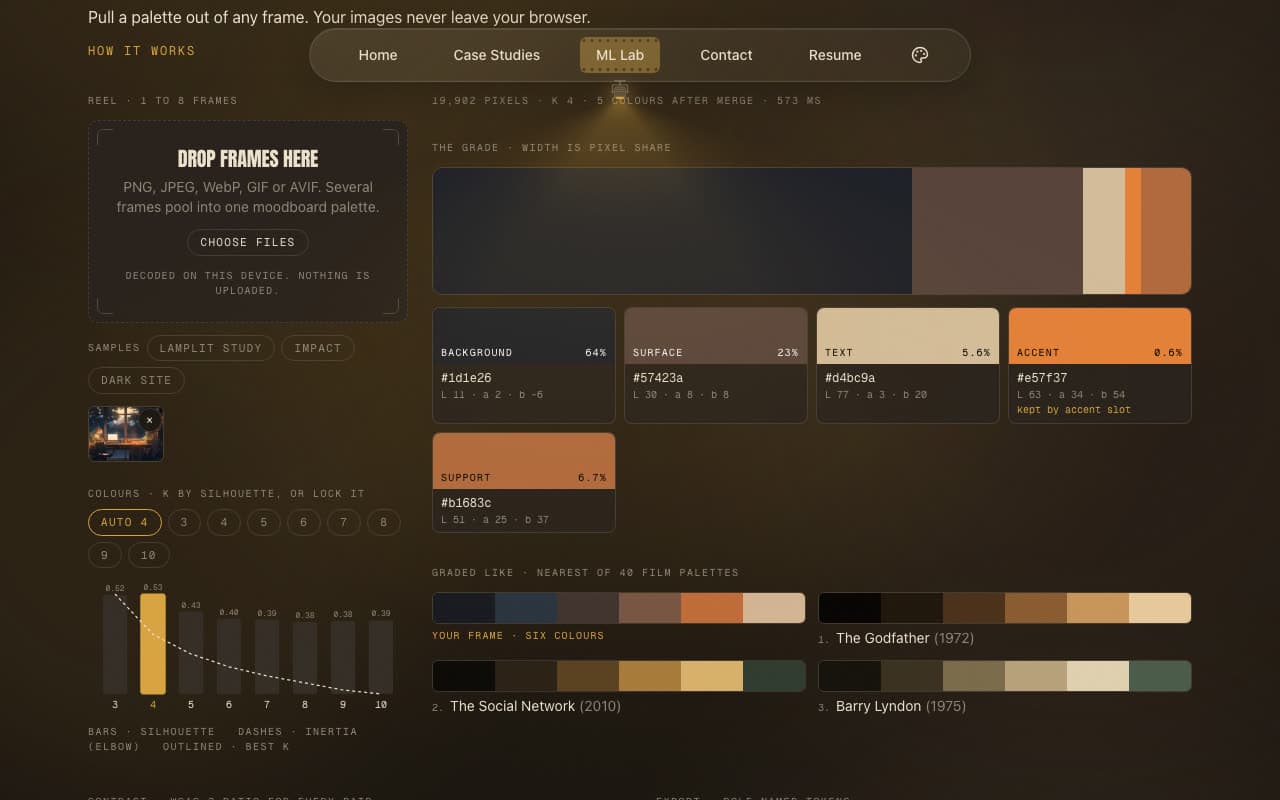
Drop up to eight images and get one palette with pixel shares, suggested roles, a WCAG contrast check for every pair and CSS or Tailwind exports. Underneath, k-means++ clusters about 20,000 CIELAB pixels in a Web Worker and silhouette picks how many colours. Your images never leave your browser.
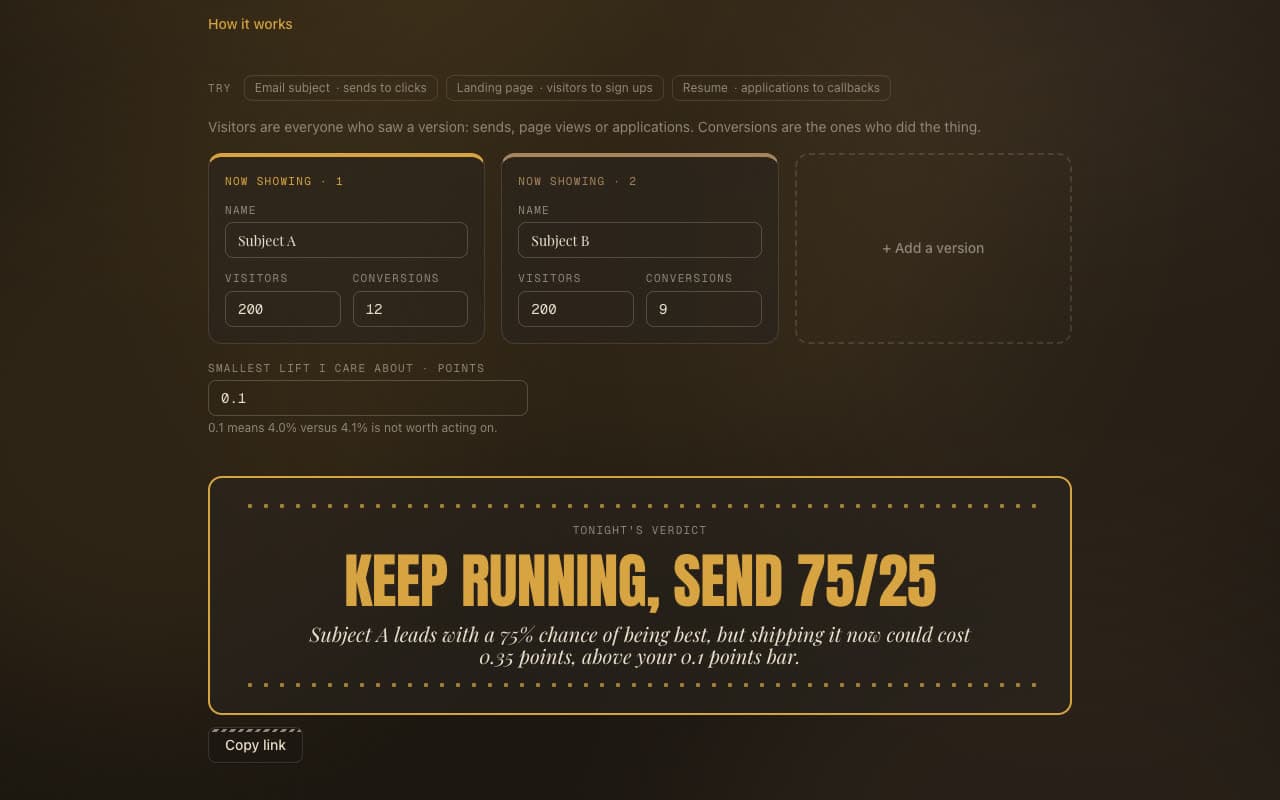
Type in visitors and conversions for up to six versions and get a plain verdict: ship, keep running, or too close to matter. Underneath, 20,000 Beta posterior draws per version give the chance each is best, the expected loss, and tomorrow's traffic split.
Every model is plain functions over arrays, with no React inside.
02
Seeded randomness
Each run can be replayed and every result reproduced.
03
Never freezes
Training runs in small slices per animation frame or in a Web Worker, so the page never freezes.
04
Measured in Node
Every number on the notes pages comes from running the same code.
Honest limits
Sample data, simulated viewers and Final Cut's breakdown odds are synthetic or approximated by hand. Your own logs, images and numbers are used as they are.
Everything you enter stays in your browser or in the page link. Nothing is uploaded.
The full write up
Why each model works, what it got wrong, and every measured result.