A houseful of Grads
building The Digital Uplift
Co-founded out of a shared house on Vancouver Island. Spec, design, code, SEO, ads, sales and shutdown. Victoria BC, summer 2025 — the months before Botpress.
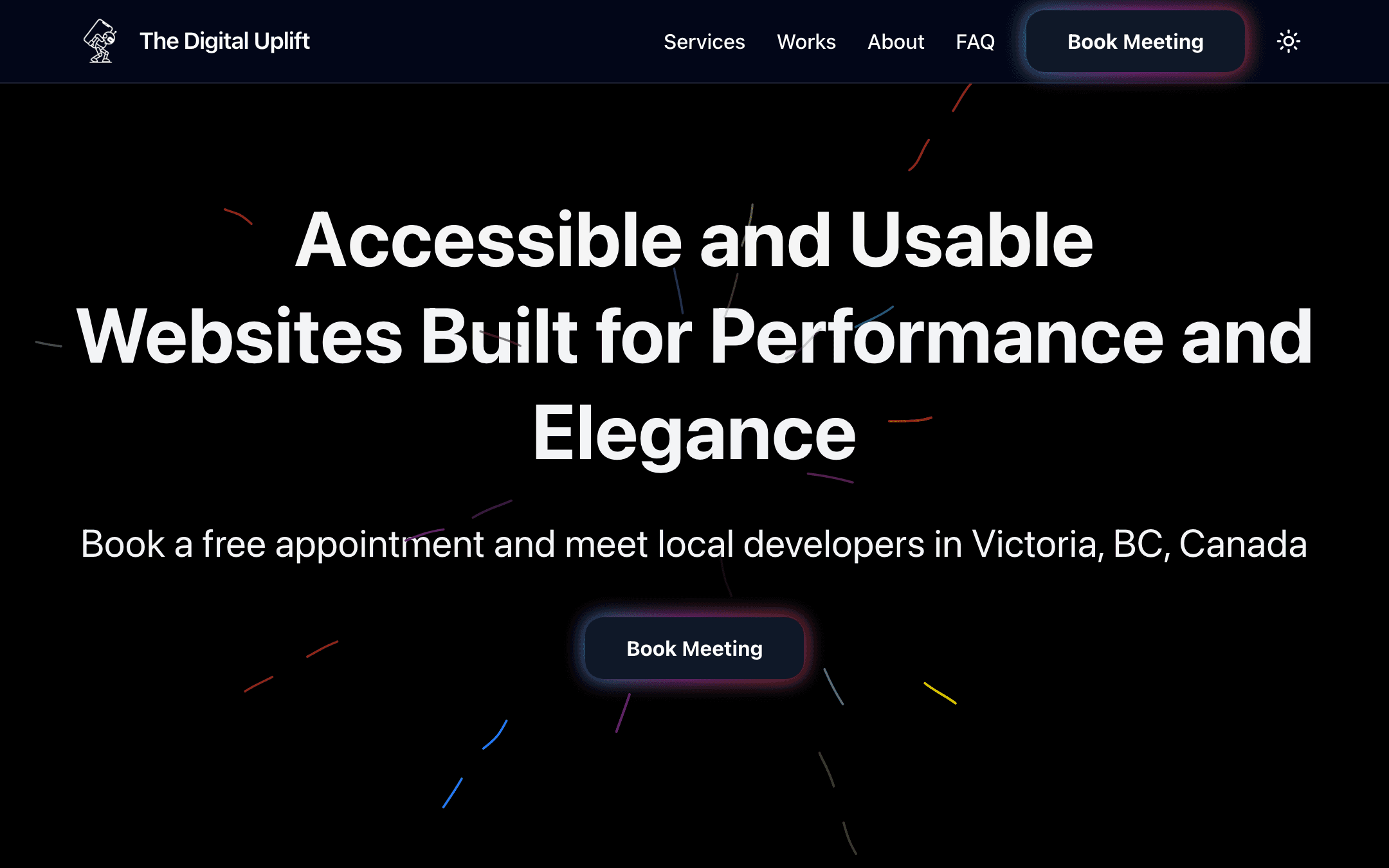
Archived and kept online, with a banner pointing anyone who still lands there back to me. The .ca domain has since lapsed; the build itself is preserved on Vercel.
Visit the archived siteWe were a group of recent grads sharing a house, out of North Island College, Vancouver Island University and the University of Victoria. By the end of 2024 we had all noticed the same thing: AI had got good enough at writing code that a real, working site no longer took the hours an agency was still billing for.
And Vancouver Island is full of boutique businesses, the hidden gems every local knows about, with no website at all, or one built on WordPress or Wix that loaded in six seconds and ranked nowhere. So we built automated workflows that turned out small, clean sites, nothing they did not need, complete on the parts they did, at the lowest price we could still deliver properly at.
The point was never the margin. It was to put our work somewhere real, and to get these places found. I took the build: the studio site itself, and the sites we shipped from it.
SEO-first route architecture
Every buying question a local owner types got its own static route, not a tab inside one page. /why-you-should-avoid-wordpress-and-wix-for-site-performance, /pagespeed-insights-100-canadian-web-development, one per city served. Twenty-three routes, each with its own metadata, OG image and canonical, all statically prerendered at build so crawlers and buyers hit finished HTML. The site was the ad spend multiplier, not a brochure.
A performance budget I sold from
The pitch was speed, so the site had to prove it before a call ever happened. Next.js App Router with static generation, no client JS on content routes, next/image everywhere, fonts self-hosted through next/font. That produced the 100 Lighthouse scores in SEO, Accessibility and Best Practices that became the actual sales artifact — a screenshot a prospect could not argue with.
A conversion path with no dead ends
Every route terminated in the same booking modal, wired to Google Calendar appointment schedules so a stranger could put time on my calendar without an email thread. Google Analytics behind it, Google Ads in front of it, so I could see which keyword page actually produced a conversation instead of guessing.
An AI assistant, before it was my job
I embedded a Botpress webchat assistant to answer scoping and pricing questions at 2am, when small business owners actually browse. It was the first time I shipped a production conversational agent for a real commercial funnel. Two months later that was my full-time job.
The engineering worked. The pipeline was the constraint — ad spend bought clicks faster than a studio none of us was doing full-time could turn them into signed scopes, and every hour spent selling was an hour not shipping. In September 2025 I joined Botpress as a Solutions Architect and we chose to stop taking new clients rather than run it at half attention.
So I wound it down properly instead of letting it rot: existing work finished, the site archived on Vercel, and a dismissible notice added across every route telling visitors the studio is closed and where to find me. Closing something cleanly is part of building it.
- Distribution is the hard part. The build was five weeks; the demand problem outlived it.
- A perfect Lighthouse score opens a conversation. It does not close a deal.
- Owning spec, design, code, SEO, ads, invoicing and support at once teaches scope discipline no ticket ever will.
- Shipping the whole business end-to-end is the closest thing to the client engagements I run now.